🍄💀 Sanctified Decay
This text is drawn from the Rotwhite Archive, expanded here as a written companion to Decay for Clout. The Rotwhite Expanse is not a place. It is a diagnosis.
‘No pain without polish. Only stillness is shared’.
You have seen them do it. You have stood at enough distance to watch the whole sequence without being pulled into it, the way you might watch weather move across a valley from higher ground, with the particular detachment of someone who understands what they are seeing and has stopped expecting it to be anything other than what it is. You have watched them find the ruin and immediately begin to curate it. The crouch, the angle, the light adjusted until the decay looks intentional, until the collapse looks considered, until the rot achieves the quality of something that was always meant to look like this, that was always meant to be beautiful, that was always meant to be shared.
You have watched them hashtag it.
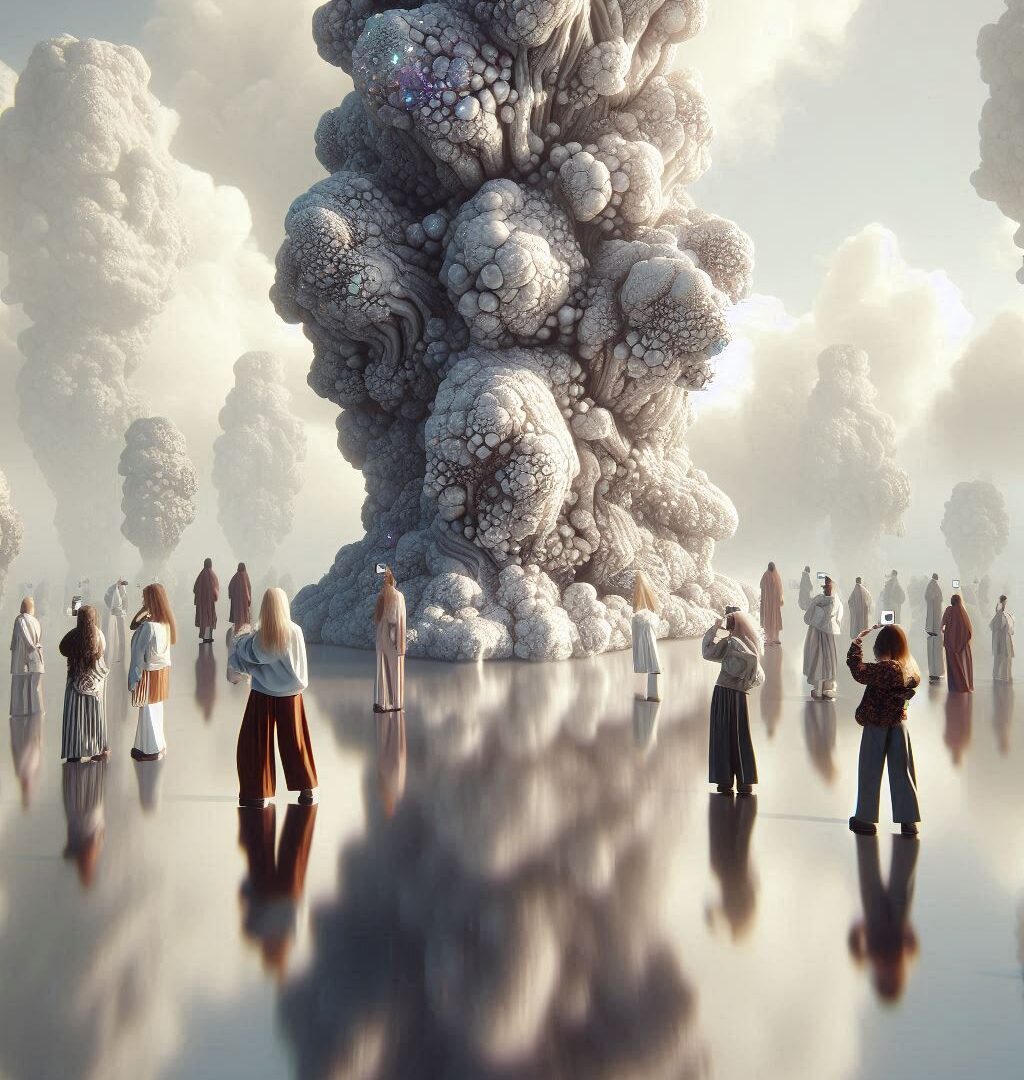
The Rotwhite Expanse stretches endlessly beneath a sky without a sun. Above, there is no firmament, only the illusion of height, a vast vault of pale nothing where clouds hang too still, too swollen, as if waiting to be harvested. No light filters from above, no warmth, no wind, no promise of storm. The heavens do not turn here. Time has no leverage against this place. The world is swathed in pale spectral white, a terrain that looks like fog made solid, cushioning every footfall with a hushed, matted give, like ash soaked into fleece. Soft footing for soft minds. Everything here yields eventually. Each step lands with the faintest resistance, as though the ground resents the intrusion but lacks the strength to protest. Beneath that surface, things shift. Not earth, not soil, but something fibrous, something sodden and full of old breath. It yields, reluctantly.
It is not snow. It is not dust. It is something older, unnameable, and entirely still, settled into its own silence for longer than breath has existed. An ethereal glow leaks from the ground itself, illuminating the landscape with a diffuse, directionless twilight. There is no source. No variance. The light simply is, heavy and indifferent. The shadows cast by every object, most of all the monoliths, are impossibly long, shifting slightly even though no wind stirs, not random shifts but something slower and deeper, as if the earth beneath were breathing in its sleep.
Even the land understands patience better than they do.
The silence here is not the absence of sound but a hollow pressure that fills the ears like descending into deep water, worms its way inward, soft and dense, pushing against the bones behind the eyes until even thought feels sodden. The air carries a metallic tang, copper and something deeper, bitter, blood left to sour beneath stone, clinging to the tongue and settling at the back of the throat, mingled with the dry scent of ancient dust and spoiled minerals. It coats the teeth in something thin and unseen, like licking the rim of a forgotten chalice.
They would call it aesthetic. Airborne ambiance. Another filter. Another caption.
There is no wildlife here. No vegetation. No sound but the weight of breath against bone. Nothing survives here with intention. Nothing wanders by mistake. The only motion is upward, slow and deliberate, born from beneath.
And then, the monoliths.
Towering shapes, each grotesque and baroque in form, rise from the terrain like tumours from the earth. They are not natural. Bronze-like in surface but corroded and blotched with sickly greens, bleeding purples, rust-reds, oxidised as if weeping through the ages. Up close the colour shifts again, taking on bruised tones, the palette of a body left too long beneath water. From a distance they might appear as statues or obelisks, but proximity betrays their origin. Thorn-like protrusions twist from their cores. Fleshy bulges calcified into hard matter. Cavities yawn like mouths in silent scream, ringed with nodules like barnacles and fused organs. Some seep a faint resin, dried to a crust like scabbed-over wounds. Others gape hollow and dry, empty as famine. Some surfaces feel warm, almost pulsing under the touch, coarse like coral in places, disturbingly smooth in others, soft in patches with a give like cartilage beneath stretched skin. Others are sharp, etched with patterns that resemble veins and tendrils more than carving. There is a memory of heat beneath the chill. A breath caught mid-exhale.
And yet they queue to photograph it. They pose against it. Ruinscore. Decaycore. Rot-chic. They think there is art in their ignorance. They think there is empowerment in their exposure. They think there is virtue in the angle of their necks against collapse.
They were once people. That truth is etched not just in the forms but in the uncanny details: a curve of a cheek turned to metal, an open palm reaching upward before hardening forever, the curve of a lip frozen between words, a wrist strained mid-gesture, a spine arched in final refusal. Nobody knows how it happened, whether they were consumed or offered. But the land is full of them, and none are identical. Each monolith is a soul disfigured, stretched into permanence. None of them seem to scream anymore.
Stillness photographs better. Stillness sells better. No one pays for pain without polish anymore.
Sometimes, when one stands still enough, a low hum can be felt rather than heard, just below the ribs, as though the monoliths themselves are murmuring in a frequency not meant for the living. It moves beneath the sternum like a hand pressed against flesh from inside, rhythmic and patient. Some twitch. Only slightly. As if remembering. Or trying to.
They kneel for it now. Light their candles. Offer their poses. They think it is spiritual. They think it is empowerment. They think it is healing energy. They do not know the difference between decay and divinity anymore. They barter themselves to algorithms and call it alchemy. They film their own undoing and call it progress. They cry softly into cameras and call it community.
Then the mist parts ahead.
Another shape rises, slowly, haltingly, from the pale ground. A bulbous spine arcs skyward. Thorned appendages curl and shudder before locking in place. A hollow gasp echoes through the silence, as though the Expanse itself is exhaling. It smells like rot, like birth, like something returned unwilling to the shape of form. The new monolith twitches again, faintly, as if unsure whether it should still be alive. And then it is still.
And still, they will flock to it. Photograph it. Frame it. Apply soft filters. Share it with captions about rebirth, femininity, resilience, empowerment. Smile into the void. Monetise their own undoing with hashtags and ring lights. Not one of them will ask what is beneath the surface. They never do. They do not want truth. They want engagement. They are gagging for a like, a share, a heart or flame in the comments. They want to be seen, to be thought of as kind, as pretty, as relevant. They want to call the rot by a softer name and wear it like a badge, to frame their own collapse as content and distribute it for consumption by people who are doing exactly the same thing from slightly different angles, all of them performing ruin, all of them aestheticising the very thing that is taking them apart, all of them utterly convinced that visibility is the same as living.
I feel no envy. I feel no pity. What I feel, standing at this particular distance, watching this particular sequence repeat itself with the reliability of a process that has found its ideal conditions and is simply doing what processes do when nothing interrupts them, is something closer to the cold, sustained attention you give to something that is genuinely interesting in the way that only inevitable things are interesting. A specimen observed. A pattern logged. A question held without urgency, because the answer is already present in the evidence and only needs time to become undeniable.
And yet. There is a question I have not finished answering, one that arrives quietly and without invitation in the particular silence that follows observation, when the notebook is closed and the distance reasserts itself and there is nothing left to look at except the inside of one’s own certainty. The question is not whether watching from a distance is better than kneeling in the mist with a ring light. The question is whether standing apart and recording it, writing it down, giving it language, shaping it into something worth reading, is its own version of the same transaction. A different angle. A different aesthetic. A different caption for the same collapse. The flock photographs the monolith and calls it healing. The observer documents the flock and calls it clarity. Both are sharing. Both are performing a relationship to decay for an audience. The difference, if there is one, is a matter of register, not of distance. I hold this thought for exactly as long as it takes to become uncomfortable, and then I file it in the place where things go that complicate the view, and I return my attention to the Expanse, where the process continues without requiring my verdict.
How much softer must a mind become before it mistakes rot for salvation?
I do not need the answer. I only need to watch. And the watching is endless, in this place where corrosion has become content, where collapse has been ritualised and aestheticised and distributed, where the damage is so thoroughly decorated that even the damaged cannot see it anymore, where no pain reaches the surface without polish, and only stillness is shared.
The Expanse does not ask to be understood. It only asks to be witnessed.
Observation concludes. The hum remains. The monoliths continue to spread.
— Logged by the ones who watch.