⛵💀 The Art of Looking Impressive While Going Nowhere (Since 1628)
What a seventeenth-century maritime cock-up reveals about mission statements, national branding, and the tyranny of the well-maintained surface.
Sold a Warship, Given a Wreck
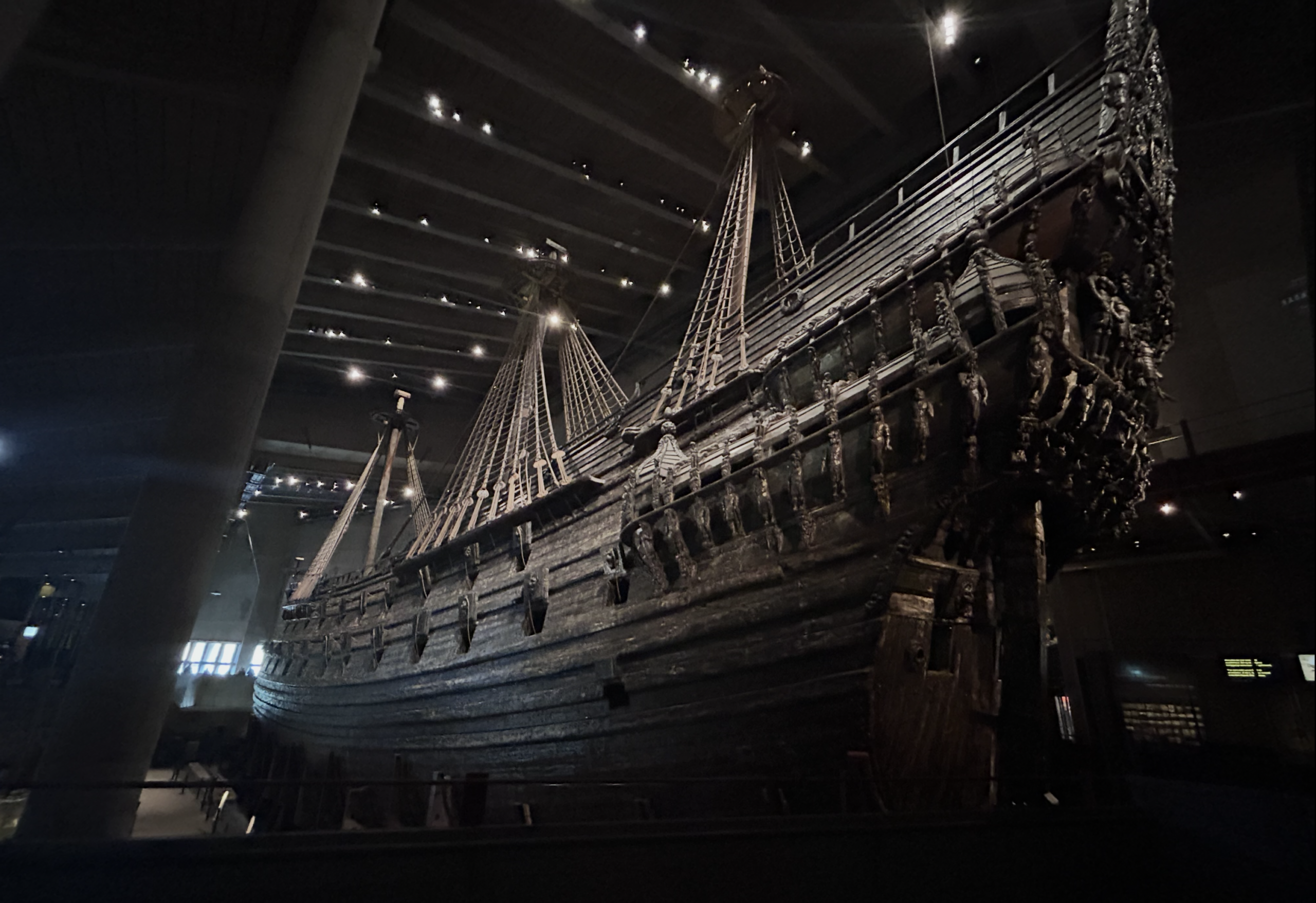
It was raining the day I went to the Vasa Museet, which felt less like weather and more like everyday life mood-lighting. Stockholm does this sort of damp, disciplined greyness that makes you suspect the sky has signed a long-term lease with the walking dead. I wasn’t trudging there as a pilgrim, despite what the museum architecture would prefer. I went because I’d been sold the idea of a warship: a preserved behemoth, salvaged from brackish Baltic water, looming in heroic silence. You know the pitch. Maritime archaeology. National pride. A triumph of preservation. A lesson in history. I expected craft, weight, gravitas, something that had actually done something. What I found was something better and worse: a spectacular failure, preserved so perfectly precisely because it never had the chance to be anything else.
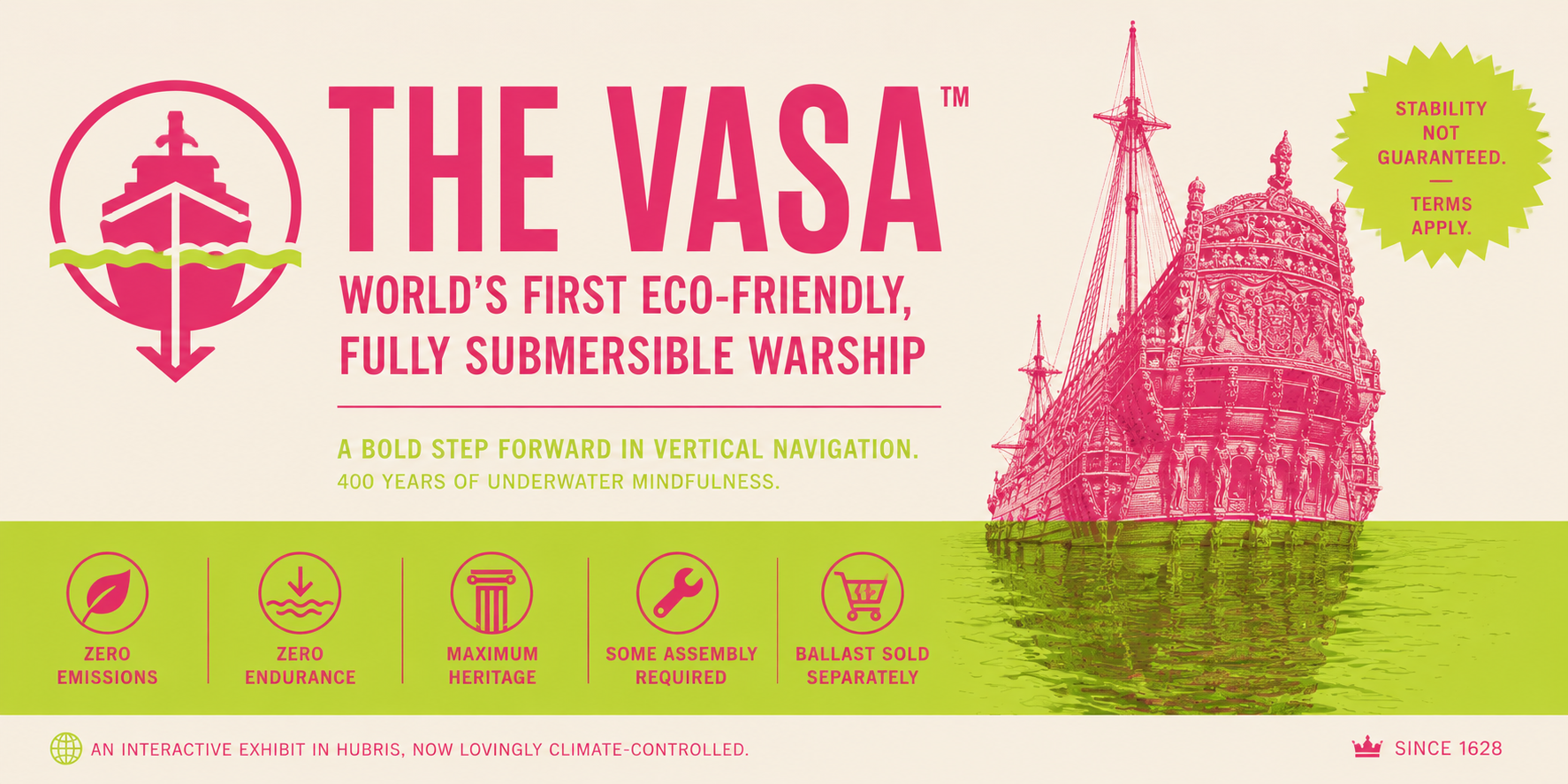
You could argue the Vasa is the world’s first, albeit failed, submarine. Instead of sailing horizontally, she sailed vertically, a decisive voyage, if not a dignified one. If they wanted to fully embrace the delusion, they could rebrand: The Vasa: World’s First Eco-Friendly, Fully Submersible Warship™ (Zero carbon emissions since 1628), complete with sustainability buzzwords and a tasteful logo. Hell, make it flatpack: some assembly required. [Pause for the fake-smile silence that passes for personality.]
Twenty Minutes of Empire and a Lifetime of Embarrassment
August 1628, the Swedish warship Vasa left Stockholm harbour armed with sixty-four bronze cannon, a crew of roughly 150, and the political expectations of a rising European power desperate to be taken seriously. She travelled less than a nautical mile. A moderate gust of wind caught her sails. She heeled. Water entered through the open lower gunports. Within approximately twenty minutes she had sunk, taking dozens with her and settling into the Baltic mud where she would remain for more than three centuries. It is possible to treat this episode as maritime farce, because it is, in fact, a warship that lasted less time than a modern coffee break, but what makes the Vasa enduring is not the brevity of her voyage. It is the scale of ambition that preceded it and the elaborate narrative that followed it. She was not merely a ship; she was a statement. And she failed not in combat but in calculation.
The engineering failure was neither mystical nor unforeseeable. Contemporary accounts describe stability tests conducted prior to launch: thirty men ordered to run back and forth across the deck to measure the vessel’s balance, the exercise halted early because the ship threatened to capsize while still tied to the dock. The warning was not subtle. The superstructure was too tall; the weight of the upper works and guns raised the centre of gravity beyond what the ballast below could counteract. The king, Gustavus Adolphus, demanded additional armament; the guns were installed; the underlying proportions were not meaningfully corrected. Naval architects were working without later centuries’ mathematical precision, but they were not complete idiots. They understood instinctively that the hull was dangerously ambitious. What happened that afternoon was not unforeseeable tragedy but the material consequence of political theatre overriding structural prudence. Physics, unlike monarchy, does not bend to prestige. It does not give a shit about symbolism.
Yet to stand before the Vasa today is to encounter not a broken machine but a baroque spectacle. Over seven hundred carved figures adorn her stern and galleries: Roman emperors, Old Testament prophets, lions, cherubs, grotesques, allegorical virtues, and, notably, Polish noblemen depicted bowing in theatrical submission. How humiliating, to carve your enemy’s defeat into oak, paint it in bright pigment, gild it in gold leaf, and then sink before anyone significant beyond your own harbour can witness the flex. Approximately 1,200 pigments were used in her original paint scheme, amplified with gold leaf intended to blaze in sunlight. She was designed not simply to fight but to be recognised. Seventeenth-century statecraft relied heavily upon visual language; sovereignty was performed as much as it was exercised. Machiavelli had already observed that appearing formidable often matters more than being so, and the Vasa embodies that principle in oak and tar. She borrowed the iconography of empire because legitimacy could be signalled through recognisable symbols. European cosplay for empire cred, imitation dressed as inevitability, a desperate attempt to look like you belong among the heavyweights by copying the heavyweights’ tattoos.
There is nothing inherently ignoble about ornament. Beauty has accompanied power throughout history, and states have long invested in architecture, pageantry, and display as expressions of collective ambition. The problem arises when ornament outruns infrastructure, when the aesthetic declaration of strength precedes the material capacity to sustain it. In the Vasa’s case, the calculation was literal: insufficient ballast rendered the towering superstructure unstable. The lower body could not compensate for the upper display. The vessel was top-heavy because the symbolism demanded elevation. What sank her was not decoration alone but disproportion, ornament over substance, projection over proportion. The error was architectural, and the logic is painfully linear: the king wanted a statement; the statement required height and guns; the guns required weight; the weight required ballast; the ballast was insufficient. What sank was not merely timber but deference.
To be clear, the Vasa’s builders were not fools. They were craftsmen operating at the limits of contemporary knowledge. Naval architecture relied on rule of thumb, proportion, and accumulated experience rather than advanced hydrostatic modelling. However, the pressure exerted by royal ambition disrupted even that experiential wisdom. The ship stands today as a material record of what happens when display outranks engineering.
A Cathedral Built for a Cock-Up
The museum frames the ship in dim light, partly for conservation, maybe, and partly, one suspects, for atmosphere. Visitors circle the hull on ascending walkways as though engaged in a secular pilgrimage. The scale is genuinely impressive. The preservation is uncanny. And the staging is immaculate: a massive room built to spiral around this gigantic ship, celebrating a failed theatre production. The whole thing has the energy of a short-lived PR stunt that has been given an afterlife through interior design. You can feel the institutional desire for reverence, the insistence that you behave as though you’re in the presence of greatness rather than the presence of an extremely expensive lesson in what happens when you prioritise optics over stability.
Informational panels narrate the brutality of seventeenth-century naval life: disease, cramped quarters, barber-surgeons performing amputations, godawful food, the relentless exposure to salt and rot. These descriptions are accurate in a general sense. Naval service in the early modern period was harsh and often lethal. Yet the Vasa herself did not endure such conditions. She did not sail long enough for scurvy to take hold or morale to decay. ‘Life on board was hard’, the exhibition claims. Really? Was it, though? For whom? The museum goes hard trying to sell the ‘hardship of life aboard’, swinging between reality and theatre, rewriting failure into struggle rather than simply admitting, yeah… bit of a cock-up. The point is not that hardship narratives are illegitimate; it’s that this particular hardship was never lived. If the ship had floated, life would have been hard. But, it didn’t. That’s the point.
This impulse to narrativise the un-suffered hardship reveals something instructive about institutional memory. Failure, particularly public failure, is rarely left naked. It is contextualised, reframed, dignified. A miscalculation becomes ‘ambition cut short’. An engineering flaw becomes ‘a bold endeavour’. Hannah Arendt wrote about the bureaucratic tendency to dissolve responsibility into language, to render concrete actions abstract and therefore less accusatory. The Vasa’s story is not falsified in the museum, but it is softened. The ship becomes a tragic emblem rather than a cautionary misjudgement. Were most are uneasy with simple incompetence; preferring drama. We prefer a narrative arc that lets the institution keep its dignity intact. ‘It was structurally fucked and everyone knew it’ doesn’t sit as nicely on a wall panel as ‘a symbol of Sweden’s maritime aspirations’. Heritage language intervenes, and suddenly the wreck is not a wreck; it is a culturally significant object of meaning. Which it is, of course, but meaning can be manufactured as easily as carved lions.
And while we’re here: the museum is dim. Too dim. Whatever the reason, the effect is the same: you cannot fully appreciate details that you’ve been told are important. They’re missing a trick. No interactive screens. No guided close-ups. As far as I could tell, there’s no way to view the inside of the ship, even though there’s a walkway built into it. You’d think they’d install a few cameras so visitors could explore different sections virtually, zoom in, actually get curious. They’ve got the structure. They just haven’t used it.
Because transparency is dangerous. Real interactivity, real visibility into the ship’s guts, real close-ups of the engineering choices, real blunt explanation of how vanity and deference turned into drowning, would shift the visitor from reverence to judgement. Mood keeps you compliant. Mood keeps you grateful. Mood keeps you from asking the wrong questions, like why the museum seems more comfortable staging the Vasa as a martyr than presenting it as an administrative catastrophe with a body count. This is the quiet genius of heritage: it turns scrutiny into aesthetic experience. You don’t interrogate a cathedral; you absorb it. You don’t ask whether the lighting is manipulating you; you assume you are meant to feel small. And once you accept that feeling, the narrative can do whatever it likes.
It is almost admirable how far they have gone to retroactively invent a whole maritime struggle for a ship that never made it far enough for someone to even get seasick. Reality and theatre blur, and the blur is the point. If failure can be aestheticised, it can be made palatable. If it can be made palatable, it can be sold. If it can be sold, it can become heritage.
The ship becomes solemn rather than stupid. The museum doesn’t need to lie; it only needs to manage where you look. It’s the same trick modern institutions use everywhere: make the setting impressive, make the language reassuring, keep the audience slightly awed, and the structural weaknesses remain politely out of focus.
Which, frankly, is the most Vasa-like decision they could make.
This is not an argument against preservation or pride. The conservation effort that recovered and stabilised the Vasa is extraordinary technical work. But rather, the Vasa provides a material case study in what occurs when symbolism outgrows structure. The lesson is civilisational. We live in systems increasingly dominated by recognisable symbols. Recognition arrives early. The audit arrives late. And then everyone acts shocked when the wind rises.
Laminated Mission Statements and Other Modern Ballast
It would be tempting to confine this to a historical anecdote, a curiosity of early modern Europe. Yet the structural logic that doomed the Vasa did not vanish with sail power. It migrated into other domains, became more sophisticated, gained a PowerPoint template, and learned to say ‘stakeholders’ with a straight face. Modern societies are no less invested in the projection of competence, virtue, and cohesion.
Guy Debord described a culture in which representation replaces lived reality, where the image becomes the primary mode of social organisation; Jean Baudrillard pushed the idea into the realm of simulation, where the copy becomes more persuasive than the original. The Vasa anticipated this perfectly. It was a floating spectacle that never proved its claim. The representation was intact; the structure was not.
Consider the contemporary corporate environment. Organisations produce elaborate mission statements proclaiming integrity, sustainability, and human-centred values while internal structures often incentivise the opposite. The rhetoric is always soothing: ‘you matter’, ‘customer focused’, ‘do the right thing’, ‘we care about the planet’, delivered by people, particularly in management and HR, who can be, without exaggeration, some of the biggest cunts you’ll ever meet. Petty little tyrants with laminated mission statements. None of this means values are fraudulent, although lets be honest most of the time they are. It means they are often used as décor. They become carvings on the stern: visible from a distance, useful for signalling membership in the moral club. Meanwhile the ballast, working conditions, real accountability, structural integrity, remains neglected. Max Weber’s analysis of bureaucratic rationality explains part of this: procedure multiplies, responsibility diffuses, and a system can become extremely efficient at performing itself while becoming morally detached from outcomes. The meeting becomes more important than the decision. The process becomes the product. The organisation looks busy, looks aligned, looks serious, while doing sod all that could survive a gust of wind.
The same pattern scales down to the level of everyday work, and living in Sweden makes it difficult not to notice because the surface is so well maintained. People busy-body themselves into importance: a suspicious number of meetings to plan the meetings that will eventually plan the plan, all of which could have been emails, except an email does not let you be seen being busy. The MacBook open in the kitchen like set dressing, as though the laptop were proof of contribution. This is the Vasa’s logic in miniature. The carvings signalled power to anyone watching from the harbour; the open laptop signals work to anyone watching from the corridor, and in both cases the signal is the point and the substance is optional. Work becomes theatre, productivity becomes costume, and because the surface is calm the performance is rarely questioned. It is simply absorbed into the national aesthetic of order.
Snakes in the Grass, Maintaining a Good Atmosphere
National performance art operates the same way. Entire countries polish their superiority complexes for export. Sweden is no exception, clean, calm, quiet, morally branded. Kool-Aid culture, sugar-free. This is not a claim that Sweden is uniquely fake, or uniquely bad, or uniquely anything, although from experience they are definitely trying to lead the charge; but it is a claim that Sweden has become a particularly efficient case study in how a nation can convert image into diplomatic capital. The brand is not entirely invented. But the brand also functions as an armour against critique, and when you live inside it, you begin to notice how often harmony is maintained by silence rather than genuine agreement. Tocqueville warned of democratic conformity not through overt repression but through social pressure, a soft tyranny that discourages deviation by making deviation socially expensive. In Sweden, the pressure often wears a politely dead face. People will agree with anything publicly, verbally and silently (silence is complicit), and then undo it behind closed doors or behind your back. Back home, we call people like this snakes in the grass. Here it is more likely to be described as ‘maintaining a good atmosphere’. Image management disguised as harmony. Hollow af.
The point about niceness is that it doesn’t function as kindness; it functions as enforcement. In places where direct confrontation is culturally discouraged, ‘nice’ becomes a weapon because it defines the boundaries of acceptable reality. The rule is not ‘be good’; the rule is ‘do not disturb the atmosphere’. Once that becomes the priority, truth turns into a social offence. You don’t need censorship when you can make disagreement feel impolite. You don’t need authority when you can make dissent look like a personality flaw. This is why consensus cultures can be so suffocating: the price of belonging is not just agreement but performance, and the punishment for breaking performance is not dramatic, no one shouts, but you feel the temperature drop. You become ‘difficult’. You become ‘negative’. You become the person who ‘doesn’t get it’. This is social control by mood. It scales beautifully because it recruits everyone as an unpaid guard. And it links directly back to the Vasa: a ship built to perform strength rather than embody it. The appearance of cohesion matters more than the structural reality beneath. It is not that people lie constantly; it’s that true honesty becomes a kind of rudeness, and rudeness is treated as a more serious offence than hypocrisy. Once you realise that, you see it everywhere, not just as a Swedish pathology, but as a modern one, particularly in professional environments where ‘culture’ is code for compliance and smiling is part of the job description.
And underneath all of it runs the same engine: the need to belong. The Vasa’s carvings were membership signals before they were decoration, Rome, the Bible, warrior kings, the recognisable authority codes that said this nation belongs among the great ones. Today the signalling is subtler but no less relentless, and it is sold back to you. ICA’s ‘clubs’ succeed not because of the discounts but because they offer identity, a points card that doubles as a tiny purchasable sense of being counted, especially if it is Swedish-coded. You do not just buy groceries; you buy the feeling that you are inside the circle. And Sweden is particularly good at this because the culture already treats belonging as moral cleanliness: inside the shared norms reads as good, outside them reads as difficult, suspect, faintly unhygienic. Inclusion is sold as normality and normality is sold as virtue, the same membership instinct that gilded the ship, now running on a loyalty app.
And that’s the bit people miss when they call it ‘efficient’ or ‘civil’. To me, it radiates loneliness. Not melodramatic sadness, just a persistent thinness, a sense that the social architecture has been replaced by systems that mimic community without the inconvenience of intimacy. A quiet hunger to be affirmed as part of the approved collective. A lack of independent identity papered over with national aesthetic and apathetic ritual. No one is proud, apparently; they’re just ‘quite happy with how things are’, pride in a cardigan. That is not a moral condemnation, although it could easily become one; it is an observation of mood, of social texture, of what happens when cohesion becomes more valuable than honesty.
Nobody Photographs the Ballast
The marketing is everywhere, and because it’s everywhere, you stop noticing it until something breaks. Clean trains, that people spit on. ‘Free’ healthcare, which is subsidised, not free. Blonde smiles, national identity now in Shade 10N. Clean streets that smell of piss and vomit by the main road. Oat lattes with oat ethics. Many of them are false anyway, but that is not the point. The rhetoric surrounding them turns them into symbols of superiority rather than what they are, the features of a somewhat functioning society carrying the same human mess as everywhere fucking else.
This is what makes the Vasa feel so uncannily modern. It is the perfect emblem of excessive pride and arrogance at the dangerous expense of competence. Propaganda, basically, power’s favourite tool. The ship’s aesthetic is not innovation; it’s recognition politics made wood.
When reconstructed in full colour, vivid reds, blues, and gold, the Vasa appears less like a sombre relic and more like a moving billboard. Impossible to camouflage. Shrink-wrapped for legacy before she had earned one. The reason spectacle wins is that it’s legible. It is cognitively cheap. You don’t need to know anything to be impressed by scale, gold leaf, a lion’s carved snarl, a mythic emperor pointing sternly into the future. Ballast is boring. Ballast is numbers, the kind of truth that ruins a good story and makes people feel stupid for clapping too early. Spectacle, by contrast, is democratic: anyone can consume it instantly and repeat it to someone else without embarrassment. It’s why we photograph the stern carvings instead of thinking about weight distribution.
And it’s why modern institutions behave like this too: slogans beat systems because slogans are portable. A nation can export ‘progressive’ far more easily than it can export functioning integration policy, and a corporation can do the same with ‘values’. We have built an entire civilisation around the preference for what can be seen and repeated over what must be tested and endured. The Vasa didn’t just sink because it was top-heavy; it sank because the people funding it wanted something that looked like power more than they wanted something that behaved like it, and the crowd, then as now, is always ready to applaud the façade. The irony is not that she was beautiful but that she was beauty first. Beauty is not inherently deceptive; the sequence is what matters.
It’s a weird thing to be inspired by, but the Vasa gives me the same energy as modern society. I kind of love that it was fundamentally flawed and no amount of grandiose beauty could carry it to greatness. Roughly twenty minutes was all it took to confirm it was a bit shit.
And this is not a moral panic about ‘kids these days’ or the internet or whatever. It’s older than Instagram. It’s a philosophical point about how modern social life increasingly rewards legibility over depth. The Vasa’s carvings were legible to seventeenth-century Europeans. Today’s symbols are different, virtue language, progressive branding, wellness aesthetics, corporate values, the polished persona, but the function is similar. The symbol is a passport. It says: I belong. I’m legitimate. I’m good. I’m serious. The danger arises when the symbol displaces the substance it is meant to represent.
One might object that the analogy between a seventeenth-century warship and modern bureaucratic or corporate life is overstretched. Contemporary institutions are far more complex than a single wooden vessel. They are supposed to be subject to audits, regulations, market pressures, democratic scrutiny. Fine. Complexity, however, does not immunise against imbalance; it often conceals it. If you want to be taken seriously today, you must often look like you are taken seriously, by adopting the correct symbols, the correct language, the correct posture. That posture can exist with or without ballast.
The Wind Still Blows
The enduring power of the Vasa lies in her silence. She does not argue. She does not justify. She sits, immense and intact, a beautifully preserved demonstration of misalignment between aspiration and execution. She succeeded at looking formidable. She failed at floating. That inversion is not ancient history; it is a recurring pattern. Societies reward projection because projection is easy to read. Competence is often quieter, less photogenic, less glamorous. It does not glitter. It does not trend. It does not come with a carved lion and a gold-leaf guarantee.
To walk out of the museum, back into the Stockholm rain, is to leave not with awe but with accuracy. I came looking for craft, and you do get that. But what I found was performance. When ballast is sacrificed for display, collapse is only deferred. The Vasa required a single gust. Modern institutions may take longer, financial stress, scandal, the slow leak of credibility, but the principle holds.
Designed to be seen, not to survive, she sank. IKEA sponsorship would be the honest ending.
The wind does not care what you looked like before it arrived.
— WRITTEN BY THE ONE WHO WALKED BACK OUT INTO THE RAIN.