🗣️⚖️ The Tyranny of the Tender
Found where a substantial amount of do-gooders bloom the loudest and the weakest minds in the room sets the rules. This is a written response to the kind of moral performance that mistakes filtered speech for integrity. There is no integrity in comfortable lies because fake honesty is nothing more than highly curated politeness.
There’s a kind of psyodo intellectual moral performance art that thrives on Substack. Quotos. Easy likes for easy virtue. Every platform breeds its imitators. Substack just traded filters for footnotes disguised as ethics. The performance is the same. Curate your compassion, package your conscience, sell it back as insight. The loudest empathy wins.
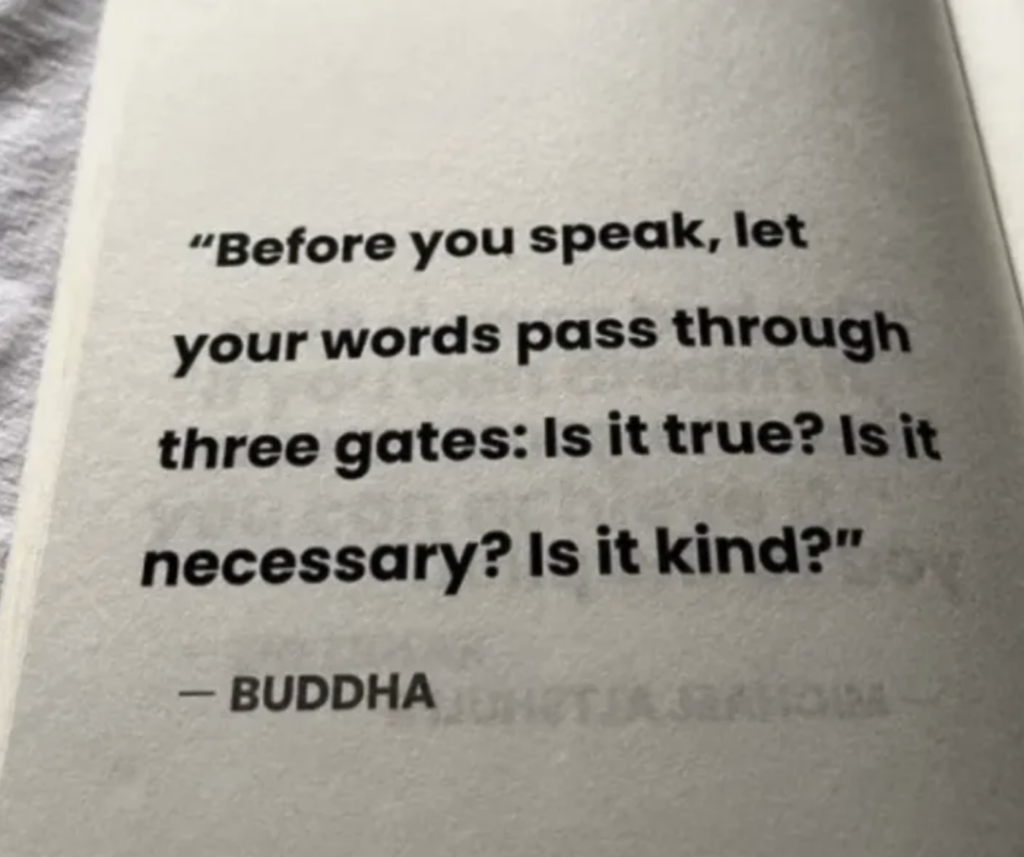
You know the one. ‘Before you speak, ask yourself: is it true, is it necessary, is it kind.’ The quote gets pinned mostly to Buddha, but also to Rumi, Socrates, whoever sounds shareable that day. No one knows where it came from. Fitting, really. The internet loves an orphaned gospel written by an unverified saint. But it looks good on paper, right? Especially when you do the accompanied bare minimum ‘that includes what you say online.’
But if we’re always filtering through true, necessary and kind, aren’t we just gutting speech until it’s soft enough to swallow? Honesty? Probably not, censorship dressed as virtue, yeah, absolutely.
The philosophy: comfort is not the same as truth
Start with the oldest dishonesty there is: the one we tell ourselves. Human beings do not actually want the truth. We want to be soothed. We reach for the comforting story the way a hand reaches for a bannister in the dark, and we will choose the version of events that lets us keep functioning over the version that is accurate almost every single time. Nietzsche saw this clearly and called it, more or less, the will to ignorance, the deep human preference for the illusion that lets you sleep over the fact that keeps you awake. We are myth-making animals. We run on shared stories, soft lies, the agreed fictions that let strangers share a lift without screaming.Civilisation is, in part, a very long agreement about which truths we will all politely decline to mention.
So far, so understandable. And here is what the slogan never gets to. Nietzsche understood that a suppressed truth does not vanish. It is not neutralised by being unspoken. It goes underground and it ferments. It curdles into resentment, into malice, into the slow private rot of a person who has swallowed too many things they should have said aloud, until the unspoken thing is doing more damage in the dark than it ever could have done in the light. The lie that protects you today is the infection that spreads tomorrow. He called the alternative Redlichkeit: intellectual integrity, a rigorous and often brutal truthfulness, the refusal to flinch from a real thing simply because it is unpleasant to look at. And he was honest about its price. The person who practises it, who strips away the comforting illusions other people are still living inside, must possess what he called the courage to be hated, and must accept a kind of solitude, because a society built on shared myth will treat the myth-breaker as a threat. He was not arguing for cruelty. He was arguing that dishonesty, however gentle, however well-meant, is its own quiet violence, and that it is usually the more dangerous of the two.
Hold that against ‘true, necessary, kind’ and watch it buckle. Because here is the part the saints never mention: a lie can be both kind and necessary. Lies can be convenient. They can protect reputations, soothe egos, preserve the illusions everyone has silently agreed to maintain. They can stop the bleeding and let the infection spread underneath, exactly as Nietzsche said. So if kindness and necessity can serve a lie just as easily, just as comfortably, as they serve the truth, then they are worthless as tests of whether a thing should be said. They do not measure honesty. They measure comfort. The slogan collapses the instant you lean any weight on it, which is precisely why nobody is ever encouraged to lean.
And there is a deeper cheat underneath even that. The slogan quietly rewrites the meaning of kindness itself. Kindness becomes whatever preserves comfort, whatever avoids friction, whatever prevents embarrassment, and then it congratulates itself on its compassion. But real kindness has never worked like that. A doctor delivering a bad diagnosis is being kind. A friend telling you your partner is cheating is being kind. The person who stages the intervention, who tells you the work isn’t good enough yet, who says the thing everyone else has decided to spare you, is being kind in the only sense that has ever mattered: they are sacrificing their own comfort on your behalf. What the slogan calls kindness is niceness, and they are not the same animal. Kindness is willing to wound in order to heal. Niceness only wants the appearance of harmony, and it will happily watch you walk into the propeller rather than spoil the mood. This is not kindness as any honest generation understood it. It is comfort wearing kindness’s name badge.
The sociology: who is actually required to be kind
Now ask the question the slogan is built to stop you asking. Who does the filtering fall on? Because it has never fallen evenly, and it was never designed to.
The sociologist Arlie Hochschild gave it a name decades ago: emotional labour. The managed heart. The requirement, in certain jobs and on certain people, not just to do the work but to perform the correct feelings while doing it, to produce warmth on demand, to swallow your own reaction and serve back something palatable, and to do it so seamlessly that it doesn’t read as labour at all. It is work, but it is the kind of work that gets called personality, or manners, or simply being nice, so that the people doing it are never credited for the effort and never permitted to stop. And it falls, overwhelmingly and predictably, on women. Notice, too, which of the two virtues is actually being demanded, because it is never kindness. Kindness is disruptive. Kindness tells the manager her restructure is an incompetent disaster, tells the friend her fiancé is a liar, refuses to let the comfortable thing stand. What is demanded is niceness: the smoothing, the softening, the cushioning, the perpetual management of other people’s pathetic weather requirments. It is the same machine wearing different name badges, niceness at the dinner table, civility in the office, professionalism in the email, emotional labour on the shop floor.
I have been on the receiving end of the enforcement, and here is the part that the tidy version loves to leaves out: it does not come down from men, the most. It comes sideways, from other women. I have had women, as a woman, tell me to do as I’m told. To tolerate it. To keep the peace, soften the tone, let it go, not make a thing of it, be the bigger person, which always and only ever means be the quieter one. Handed down friend to friend and mother to daughter and colleague to colleague as if it were wisdom rather than what it actually is: a survival strategy from rooms that punished women for honesty, repackaged and passed forward as good manners to the next woman in line by other women, especially in an office enviroment with women scrouging for a seat at the big boys table so they dish out the advice to keep other women around them down, and unnoticeable. That is how a leash gets inherited. Not clamped on from above, but fitted by the women already wearing one, or women who need you to wear one so they can climb above you, women who have been taught that the only thing worse than wearing it is watching someone else refuse to. A woman who declines the contract is not described as honest. She is described as difficult. Abrasive. A lot. A problem. She has breached an agreement she never signed, and the people most offended by the breach are usually the ones who have spent the longest pretending the agreement was their own idea.
The theology: discomfort is now heresy
And this is where it stops being about manners completely, because what we are actually describing is a religion.
The ‘be kind’ movement runs on the full architecture of one. It has saints: whoever trends that day, Buddha, Rumi, Brené Brown, a meme with no author and good typography. It has scripture: the quote itself, reproduced across every platform with no source and no argument, accruing authority through sheer repetition, the way a thing said often enough begins to feel true without anyone ever having proven it. It has commandments: true, necessary, kind, a holy trinity that functions less as ethics than as a gate, a checkpoint your speech must pass before it is permitted into the world. And like every religion that ever held real power, it has heresy, and it has an apparatus for dealing with heretics.
The heresy is simple. It is saying something true that makes someone uncomfortable. Not false. True. That is the modern sin. The response is not debate, because debate would mean engaging with whether the thing is actually correct, and the faithful idiot will not take that risk.The response is condemnation. The pile-on. The public penance. And it has precedent older than the internet: the stocks in the town square, the scarlet letter, the medieval penitent made to stand at the church door so the whole congregation could witness the shame. The mechanism has not changed in hundreds of years. Only the speed has.
You have watched it happen. Everyone has. Someone says the wrong thing, sometimes a genuinely ugly thing, sometimes only a clumsy one, sometimes merely a true one delivered without enough soft padding for the wet lettuce, and the congregation assembles before they have finished the sentence. The quote-tweets arrive first, then the screenshots, then the people who have located your home town based on the grass in the background, then comes the employer, partner, even contacting their children’s not off limits. By the next morning they are not a person who said a thing, they are the thing they said, flattened into a headline the whole feed can pass around like a collection plate. The apology, when it comes, is read as further evidence. It is rejected by people who decided on the rejection before it was written. Nobody involved argues with them, because nobody needs to. Heretics are not argued with. They are managed. Their words are not answered, they are flagged, contextualised, and disappeared behind the language of harm and safety, which are this church’s preferred instruments of excommunication.
You are not wrong. You are dangerous.
That is the whole machine. It is enormously more efficient to call someone dangerous than to prove them mistaken, because danger requires no evidence, only consensus, and consensus is the one thing a frightened, flattered, elective conflict-allergic crowd produces in abundance. This is a culture that has quietly decided the most fragile person in any room should set the terms for everyone else in it. That discomfort is a kind of injury. That being made to think is a kind of violence. That the correct response to an idea you dislike is not to refute it but to be protected from ever having to encounter it again. The weakest mind in the room sets the rules, and everyone else performs agreement, because performing agreement is safer than being the next name in the square. And be clear about what weakest means here, because it is not the genuinely vulnerable, who rarely get a say in anything and never get to set terms. It means minds so fragile they have learned to treat disagreement as an attack, every unfamiliar idea as a phobia, every challenge as an ism, every discomfort as a wound that the entire room is now obliged to dress. They demand safe spaces, which in practice means spaces where only the approved opinion is permitted, sealed off from any noise that might require them to think, and everyone around them is expected to conform to the most easily offended person present. Look around, whole countries reshaping themselves around its most fragile members, conceding the terms of every conversation to people with the spine of a wet lettuce, and calling the surrender progress. Claimed vulnerability is now a form of authority, the one card that wins every hand, and the people playing it best are not weak at all. They have simply noticed that in this church, the loudest wound rules the room.
What’s actually underneath it
So when they say ‘only speak if it’s true, necessary and kind’, hear it for what it is. Only speak if it won’t make anyone uncomfortable. Only speak if it costs you something and them nothing. Only speak if you have already pre-chewed it into something soft enough to swallow without a single difficult thought. That is not an ethics. It is obedience with a halo on. And notice that no one, in the entire history of this slogan, has ever been told their truth was too kind. The gate only swings one way, and it was hung that way on purpose.
Truth is often cruel, frequently pointless, regularly ugly. But it is the only thing that doesn’t rot. Lies ferment, no matter how well-intentioned, no matter how gently delivered, no matter how many people clapped when they were told. And the people most devoted to kindness are so reliably the least honest, the spaces most obsessed with safety are so rarely safe for anyone who hasn’t learned to speak in the approved register.
The filter was never built to protect the vulnerable. It was built to protect the comfortable, and to hand them a sacred-sounding language for silencing anyone who threatens that comfort. A culture that can no longer tell kindness from niceness does not become kinder. It becomes nicer, and quieter, and more polished, and more hollow, until one day it discovers it has niced itself out of the ability to tell the truth at all. Kindness will sit in the wreckage of a hard truth with you. Niceness will leave you inside the lie, because the lie was easier company.
Kindness is willing to cost you something. Niceness never is.
— Written by the one who never learned to keep it nice.