🪙🎰 A Fortune in Coppers
A caravan by the Welsh coast, a tub of 2ps saved all year, and an education in home I didn’t clock until it was over.
The first thing is the noise. Coins on coins, a thousand 2ps shoved back and forth under glass, the whole arcade roaring with it, and somewhere underneath, the electronic gurgle of machines promising more than they ever paid. That and the smell. Salt and vinegar, hot off a polystyrene tray of chips, cut with fag smoke, because it was the early 2000s and everyone smoked everywhere, my nan loudest of all. If you want to put me back there in a second, that’s it. Vinegar and smoke. I spent a bit in Sweden as an adult and couldn’t get vinegar for love nor money, and I have never felt further from home.
We saved up for it all year. Not just the caravan, though that got saved for too, sometimes eight hundred quid for the week and worth every coin. The 2ps as well. A tub of them, fed all year, carried down and cashed at the machine that turned your notes into pounds and your pounds into a waterfall of coppers, pouring into the tub with a sound I can still hear. If you ran dry there was a desk where you could ask for more. That was the economy of the place. Small coins, put by slowly, spent on something that gave you back almost nothing and felt like everything.
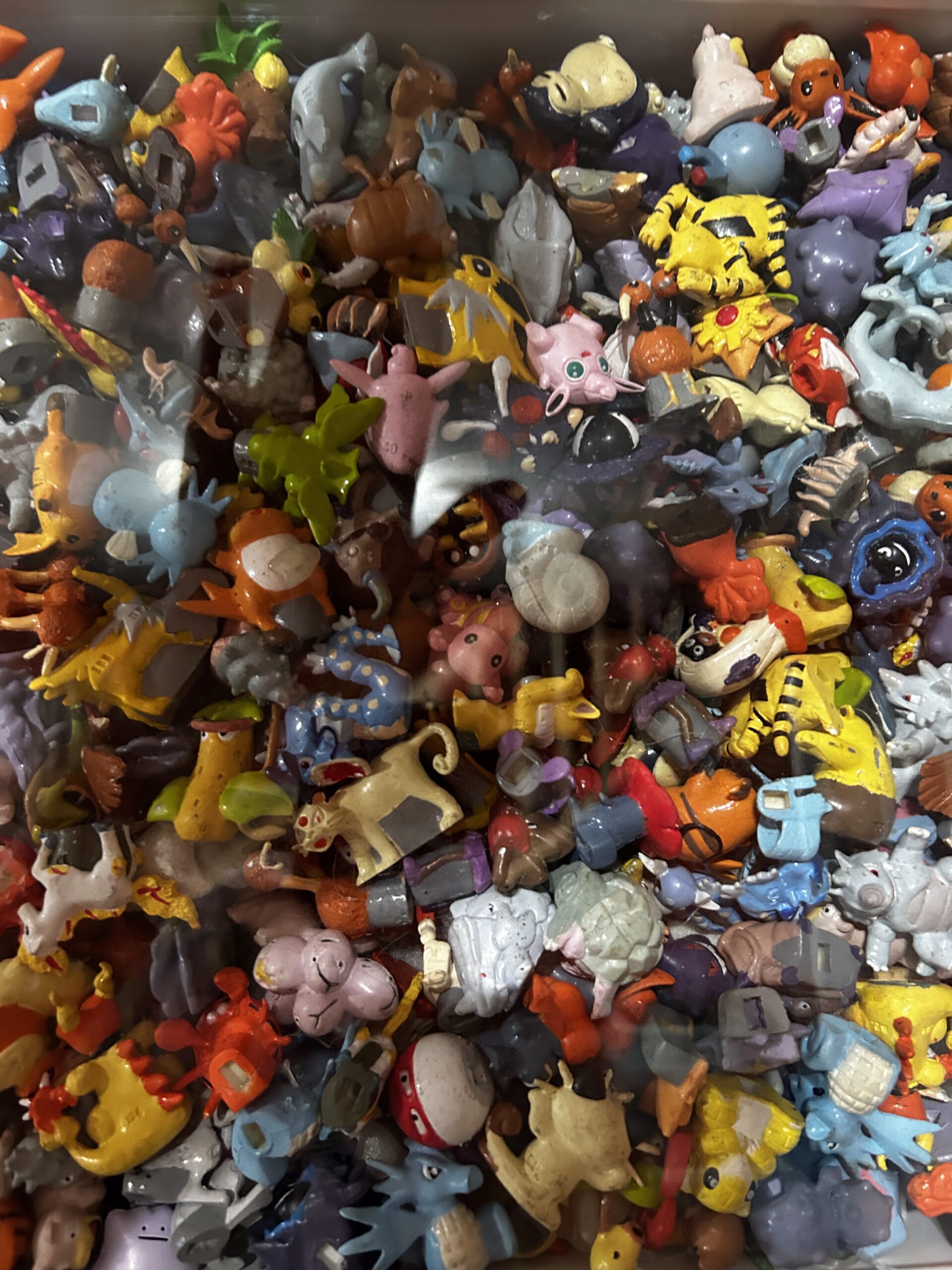
What you were chasing wasn’t the money. It was the tokens, hot pink and every other colour, plastic discs and paper tickets that spooled out on a reel when the shelf finally tipped, and the little prizes riding on top of the coins. Pokémon figures in their own branded bags, two or three to a bag, resting on the shelf waiting to be pushed over the edge. I still have them. The more tokens and tickets you stacked up, the bigger the prize behind the desk, soft teddies, proper stuff, but the bags were the treasure. You poured a fortune in coppers in to win something worth nothing. Everyone knew the maths. Nobody cared. That was the point, though I wouldn’t have called it that then. You weren’t there to come out ahead. You were there because the place, the week, the whole ritual of it, was yours.
He drove us down. My dad, who didn’t holiday, who was happiest in his own house with his own routines and saw no reason to leave them, would still load the car once a year and take us to the sea, because it was for me and my nan, not for him. The way you knew you were nearly there was the speed bumps. Porthcawl had these vicious high ones through the middle of it, and my dad, at various points, had a Renault Laguna that sat too low to clear them. You’d hear it before you felt it. The scrape. That tearing knock of the exhaust dragging over concrete, and the second it came you knew exactly what was coming next.
He’d start building before the next one. You could see it climb up through him. He’d slow the car right down, crawling at the bump like he could baby it over by sheer will, time going backwards, the whole car holding its breath, everyone silently asking the same thing: is this the one that pinches the exhaust, or not. It was always the one. It caught every time, year after year, like clockwork, and then he’d go off, fist on the wheel, fierce and loud and aggressive, raging in a bubble that nobody else lived in and nobody needed to, because it was never aimed at us. It was between him and the tarmac.
And then it was over. He’d drive up, park the car, walk down to the fair, and stand next to me feeding 2ps into a machine like none of it had happened. That was the shape of him. The rage came once a season, did its work, and left, and underneath it he was the steadiest man I knew. I didn’t have the words for that as a kid. I just knew that whatever my dad was angry at, it was never me, and it was never going to be.
My nan held court from a corner. She had her spots, the same ones every year, and the main one was a table in the arcade where she’d sit with a fag going, a cup of tea, sometimes a tray of chips, watching the place over the top of all of it. She had others. A bench at the top of the fair, by a little kids’ train ride, closest to where the market set up on the gravel behind the rollercoasters. The café down by the exit to the beach, once people she liked had taken it over. She moved between them on bad legs and a stick, and wherever she landed, that became the center of things. You always knew where she was. That was the point of her.
She’d send me off on errands from her corner. Sticks of rock, and always humbugs, a bag of humbugs for my grandad, who never came, who stayed home all week with the dogs and his newspaper and wanted for nothing except, apparently, humbugs carried back from a Welsh seaside he had no interest in visiting. Couldnt have given any less of a toss if he tried. That was them. She ran the supply line to a man who wouldn’t leave his dinning table chair, and neither of them would have called it love, and that’s exactly what it was.
There are people you’d tell to grow a spine. My nan grew one and bolted nails and acid to it. She was the boss, the matriarch, the one who ran the family and kept everyone in line, and her territory was family, that was the whole of her law. She’d done hard things and bad ones, she could take a punch and throw one well into old age, and she was always, without exception, on my side, even when she knew full well I was in the wrong and being a ‘little madam’ about it. That was the deal. You did not have to be good to be hers. You only had to be hers.
Which is why the strangers never stood a chance. I was on the machines on my own one day, feeding the pushers, when an older couple came up and started asking questions. Who are you here with? You here on your own? Did you want to try another machine? I did what I’d been taught, kept my eyes down, said nothing, didn’t give them an inch, didn’t so much as turn my head, because you don’t, because in a busy place they can make it look like a family simply walking out the door, and then you’re gone. So I stayed put and fed my coins in and said nothing. And then it came, from across the arcade, over the racket of a thousand 2ps: ‘OY CUNT.’ Just that. Sharp, guttural, final, a noise no one else on earth could make the way she made it. That was all it took. That was the entire conversation. The couple evaporated, and my nan went back to her tea, and I went back to my machine, and the matter was closed.
We went abroad once, first time ever. Spain, fourteen days, and I remember thinking it was supposed to feel like something. It didn’t. The whole place ran on people lying very still in the sun, roasting themselves by the pool and the sea like a row of turkeys, turning over now and then to do the other side like a rotisserie chicken. My mam was one of them, happy as anything on a lounger for hours. Me and my dad couldn’t do it. We managed one pool afternoon and one sea morning in 14 days, and that was our lot, because sitting still while the day went past was not a thing either of us knew how to do. There was a whole holiday out there going to waste while everyone cooked.
So we cracked on, the pair who had to be doing something. The best day was Marine World, where an enormous pelican decided my ice cream was his and chased me for it while my cousin laughed. I refused to give up my ice cream, of course. In the end my dad had to step in and shoo the thing off into its pond. The pelican left empty-beaked. That was the holiday’s high point.
The rest we filled with markets, because the markets were the only thing out there shaped like home, the Spanish version of the stalls at Porthcawl and the ones at Resolven we stopped at on the way down. Me and my dad dug through them, and that’s where we found the jewellery box, one big compartment, the whole thing coated in polished shells. We bought it for my nan. She kept her Porthcawl photographs in it for the rest of her life. The one good thing we carried home from Spain spent the next however many years holding the place we’d rather have been.
The market was my nan’s territory too, and somewhere in her laps of it she’d buy me things. A new beach towel most years. An ornament or two. And one year, the ornaments. A dragon and a fairy, both of them bright and glittering and the most beautiful things I had ever owned. The dragon stood on a shard of pale crystal, ice-blue and frosted at the base, its body deep blue-green, its wings running from purple up into sunset pink and amber, picked out with gold. It held a clear glass orb in its front claws, mouth open, tail curled down around the crystal, the whole thing made to light up and glow from the inside. The fairy was all colour and light beside it. I was the kind of child who wanted the hidden world to be the real one, who believed somewhere under the ordinary surface of things there were fae and monsters and magic just out of sight, waiting, and these two were proof of it. Solid, glittering proof, sitting on my shelf where I could see them.
They didn’t make it out of childhood. Not by accident, and not by me. I’ll leave it there, because some things you bury by not saying them, and because the wanting never died even when the objects did. I still go looking for the hidden world under the surface of things. I just make it myself now.
I forgot all this for a while. You get older and the world gets loud and expensive and full of people insisting that happiness is somewhere else, somewhere you have to book, fly to, pay for, and if you’re not careful you start to believe them. You start thinking rest is a place with a pool and a flight number. I went looking. It took me a long time and a fair distance to work out that the thing I was looking for had already been given to me, years back, in a caravan by the sea, by two people who never once called it love and simply kept proving it.
Because that was the whole lesson, and I only understood it in hindsight. The magic was never Porthcawl. It was them. My dad, content in his own castle, who didn’t need to get away because he’d built somewhere worth staying. My nan, running her territory with a fag and a stick, whose territory was me. They made a place I never needed to escape, and I mistook the place for the magic, when the magic was always the people standing in it.
They’re both gone now. The caravan holidays, the arcade table, the speed bumps, the ‘oy cunt’ across the arcade, all of it exists only in the telling now, and in a shoebox of evidence. I still have the Pokémon figures I dug out of those 2p machines, the same tokens they were still using the last time I went, just before the world shut. The shell jewellery box should be in there with them, every summer of the place stacked inside a box made of shells. It isn’t. When he went, things fell apart, and I couldn’t tell you what happened to it, or to the photographs inside it. So the shoebox holds what it holds: a handful of plastic out of a copper economy. That’s the lot. That’s what survived.
But here’s what they gave me before they went, the thing I had to lose them to finally understand. Home isn’t a postcode. It’s not a caravan or a town or a country. Home is the one place you never need to escape, because it’s the one place you get to be entirely yourself, and once that’s in you, you carry it, and you can go anywhere. Everywhere else is a bonus. Everywhere else is a place just passing through, and it’s welcome to me as long as it aligns with, accepts, or is at least intrigued by what I’ve got to offer. And if it isn’t, it can get fucked. I’ll take my humbugs and my glittering evidence and go. I always know the way back, because the way back isn’t a road. It’s a girl a dead man raised to know exactly who she was, and to never once mistake a pool with a flight number for somewhere she belonged.
The magic was never the place. It was the people who made a place I never had to leave, and then made sure I could leave anything else.
— WRITTEN BY THE ONE WHO ALWAYS KNEW THE WAY HOME.